
Bodan
29 Aug 2026
Bodan is a family ritual and custom among Hindu Chitpavan Konkanis. According to the traditions of their lineage, Bodan is performed annually, every three years, or after auspicious ceremonies. Bodan is usually done on Tuesdays, Fridays, or Sundays. Except for the months of Paush and Chaitra during Chaturmas, this religious program dedicated to the Goddess is carried out.
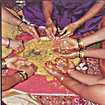
Three or five married women and one young girl are given oil and shikakai, asked to bathe well, wear silk clothes neatly, and adorn themselves with all auspicious jewelry. Everyone’s tray is arranged in a circular shape, with one tray or square kept in the middle, and a rangoli of a specific pattern is to be drawn. A brass plate is needed to fill the bodan (a ceremonial dish), which is placed on the square. Once they arrive, the married women and the young girl are worshipped in front of the Tulsi plant. First, the tulsi is worshipped, a tray is prepared, and then hot water and milk are poured over the feet of the women and the young girl, filling the tray. After that, they immediately sit to fill the bordan. They take the Annapurna from their household shrine and place it in the bodan plate. Before worshipping it, they first perform a Ganapati ritual with betel nuts and perform the Panchamrit puja. For the goddess, flour is soaked in milk with sugar to make small ornaments for the goddess. The same flour is used to make a throne and a small cup for milk. Five small lamps from the same flour are made for the aarti. The lady of the house performs the Panchamrit puja for the goddess. Around the goddess, all kinds of dishes are placed on puranpoli, and five offerings are arranged. At this time, the offering must include puran.After offering the naivedya (food offering), the Durga Aarti would be performed using lamps made of wheat. Then, those five lamps would be placed on the plate near each naivedya. Another woman in the house would wrap a gold chain around the silver container and, after letting the milk flow, would calm it down. For this worship, just like you need puran (sweet filling), you also need the panchamrit (milk, curd, ghee, honey, sugar), and at least one or two vessels. Once the lamps are extinguished, milk, curd, and other offerings would be poured over five portions for the goddess. The lady of the house would ensure everyone’s hands are ready for receiving the offerings. The offering ritual would begin. The young girl would take the goddess, money, and betel nuts from these offerings. Purán or sugar would be applied to the goddess’s mouth and then placed in the deity’s shrine. Purán would be applied to Sawashni’s hands to stop her hands from moving. A spoonful of the offering from the plate would be taken and shared with everyone as a token. Later, the rest of the offering would be stored in a box or a pot for consumption. It should not be given to any other animals, nor should it be discarded.
Bodan is a religious tradition among Chitpavan Brahmins and is not found in any other Brahmin sub-caste. The goddess has destroyed many demons like Mahishasura in the coastal areas. At that time, she had to take on many forms. Tackling the demons was a job that required a lot of strength and intelligence, which the goddess accomplished, rescuing society from trouble. People enjoy divine happiness and prosperity because of her, so this worship is meant to keep her calm and pleased. It’s a ceremony for offering devotion. Thanks to her grace, all food, ornaments, and the wonders of nature flourish, and this worship is a symbol of that. In this tradition, there is absolutely no superstition, wastefulness, carelessness, or laziness. On the contrary, from a scientific perspective, tulsi (holy basil) is important for health, which is why it is worshipped. It also reflects closeness across two or three generations, imparting values to children, and gratitude towards what sustains us. This is a clear vision. For Chitpavan Brahmins, this religiously entertaining ritual represents happiness and prosperity, and it’s a truly auspicious practice.
Courtesy - Family Deity: Ajit Patwardhan