
Navaratra
29 Aug 2026
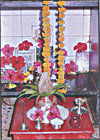
The tradition of performing Navratri from the first day (Pratipada) to the ninth day of Ashwin month is followed so that devotees receive the goddess's blessings, their happiness and prosperity increase, and misfortunes are avoided. The eight-armed goddess killed the demon Mahishasura and gave safety to the devotees, protecting them. It is said that this battle lasted for nine days. On the first day of Ashwin month, the Ghatsthapana (installation of the sacred pot) is done. First, worship the deities at home and set up the pot. Take a small plate, spread wheat on it, and place a copper vessel filled with water on top. Put coins and betel nuts in the water. Place a tamhan (clay platform) on the copper vessel, spread wheat on it, and put the deity's idol. In some places, instead of tamhan and the idol, a coconut is placed on the copper vessel, and mango leaves are placed beside it. In front of the plate, keep a conch and a bell, and perform the puja with turmeric, kumkum, rice, incense, and flowers. Make a garland from flowers and place it on top. In this way, make a garland offering each day for nine days. If a particular day has a tithi loss, then on that day offer two garlands.
On this day, wheat holds importance. Therefore, place a leaf plate in front of the pot and put sifted soil on it. Sow wheat in it and water it. Similarly, in some places, other grains are also sown.
During Navratri, keep the sprouted wheat growing for nine days, 24 hours a day.
On Lalita Panchami, in the evening, they hang a display of papads, karanjya, and sweet vadas on the pot. In some households, a homa is performed in front of the goddess on Ashtami. Up until Navami, they read Durga Path, Saptashati Path, or Bhagwat.
Also, in some homes, every day the food is cooked with specific offerings, and for nine days there is a Satvik and Brahmin meal.
When waking up during Navratri, first perform a prayer to the deity, put a garland on the pot, and do the aarti. Then remove the garland. The idol of the goddess in the vessel should be installed on the tamhan and worshiped.
Offer food by showing it and light lamps made of puran for the Aarti. They make nine, seven, or five puran lamps. Among them, one lamp is made larger. In the large lamp, five wicks should be joined together.
During Navratri, every evening they perform Aarti for the goddess, and at that time, they offer milk, sugar, or some fruit as food, which is then distributed as prasad to everyone.
Once the gantha (sacred pot) is placed, it should not be moved for nine days, and similarly, the Nandadeep (sacred lamp) should not be moved from its place. In some places, the gantha is set up in fields prepared on leaf mats.
Courtesy - Kuldaivat (family deity): Ajit Patwardhan